Listen to Your Mind
A data-driven look at music and mental health
By: Gabby O’Connell & Annie Hilgartner
With the rise of mental health challenges especially during and after Covid-19, there are many ways to work towards the improvement of one’s psychological well-being. Thoughts of feeling alone or isolated through mental health complications is still a pressing issue. According to the National Alliance on Mental Illness, (NAMI) some of the most common “self-help” techniques include Radical Acceptance, Deep Breathing, Opposite to Emotion Thinking, Mental Reframing and Emotion Awareness.
But, a lot of times these methods don’t work. When this happens, where should individuals turn to? With our research based on a dataset from Kaggle.com and spreadsheet organizing, the answer lies surprising within the beat of the music. But how does music serve as a coping method? Does genre or hours of listening affect mental health? Will age be a factor? Are certain streaming services another factor?
Data conducted by Catherine Rasgaitis, a student Computer Scientist at the University of Washington, gets these questions answered proving that there is positive correlation between music and one’s mental health. The most common belief is that music serves as a distraction but with the findings of this study, it can be a positive way to help cope with work or stress one may be feeling. When choosing to research more on our data, we were able to use Excel and Flourish to provide further data insights and visualizations.
Music & Work
While we chose to focus on some of the most common mental health struggles such as Depression and Anxiety the data clearly shows that improvements for the most part were made especially when it came to the question of listening to music while working. From the findings in our dataset, 154 people reported that they do not have music playing when working. 579 respondents have mentioned that they do listen to music during work.
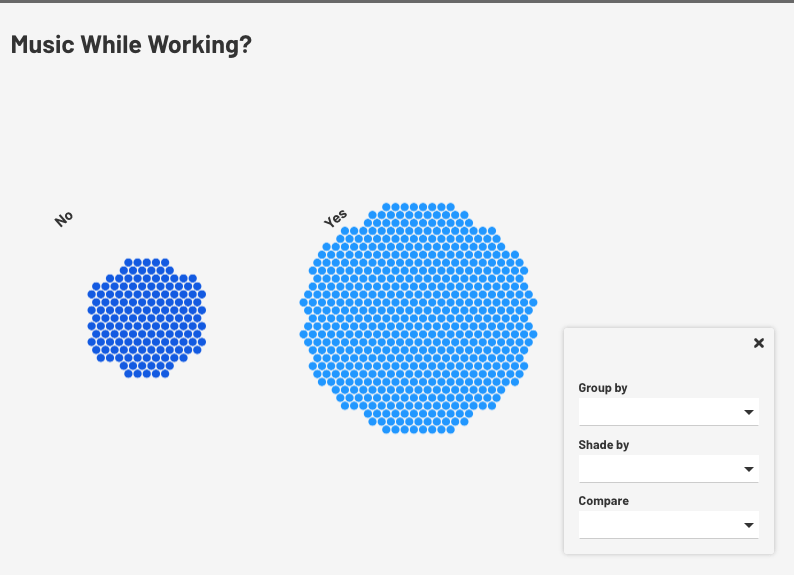
We felt that this specific way to show our findings would be effective to the audience as it shows the relevance in our data.
Numbers Don’t Lie
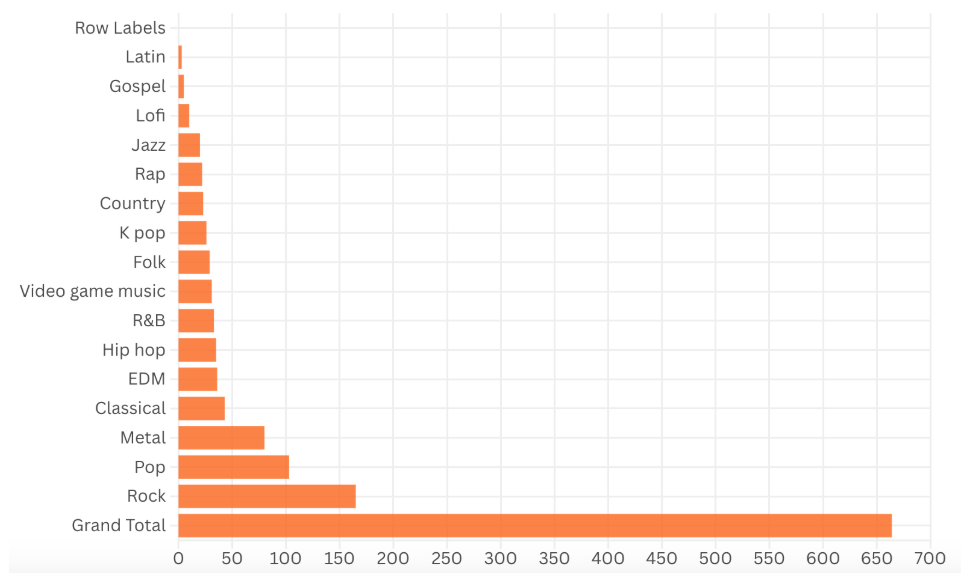
Expanding on our interest with music habits while working, we wanted to dive deeper into what genres people actually listen to. Analyzing our data and creating a visualization we were able to identify rock music stands out with 45.4% respondents identifying it as their preferred genre during work. The preference suggests that rock’s energy may help maintain focus and motivation. Pop music at 27.7% is likely due to its upbeat and familiarity striking a balance between stimulation and a good background noise. What was surprising to us was that metal attracted 18.1% of listeners letting us know that the genre’s intensity might actually draw concentration or block out any distractions. On the lower end Latin music was liked by only 4.55%, Gospel was 2.72% and Lofi at 1.82%. These lower numbers don’t mean there is a disinterest but it does mean people may listen to it in certain situations. Lofi is one that is often used with studying and associated with a calm focus environment. The distribution offers an insight not only into different tastes but also into how different genres may vary between work environments and styles.
Streaming Platforms
Adding to our exploration of music habits, we wanted to understand how people get and listen to their music, especially what streaming service they rely on when working. From the 855 survey respondents, Spotify was the dominant choice with 458 users which is more than half of the data. We found this not surprising because spotify contains a broad genre selection, it is very simple to use, and it has playlists made for work and focus which makes a great choice for listening while trying to get things done. Other streaming services we saw were significantly less used. Youtube music was next on the list with 94 users, followed by Apple Music with 51, and then Pandora with only 11 users. 71 of the survey respondents said they don’t use a streaming service at all which means they may rely on the radio or prefer silence during work. 50 of the respondents indicated they use a platform that was not listed in the options which opens the door to niche services or regional ones. While there is a big assortment in how people access their music Spotify has a strong lead as a go-to choice for streaming platforms in a work setting.

Final Takeaways
After learning more about our data and the story it tells, we realize that mental health is something that we all struggle with. Finding ways that we can help cope with feeling overwhelmed and stressed out are different for everyone. This coping mechanism is one of many that could possibly work for some. Students especially feel burnt-out or stressed at the end of the semester, so finding ways to relax and bring your attention back to your mental health is important for us all. We hope that our findings and graphics can serve as a way to inform our audience with another way to cope with mental health. And surprisingly music can be a way to help.
 Gabrielle O'Connell